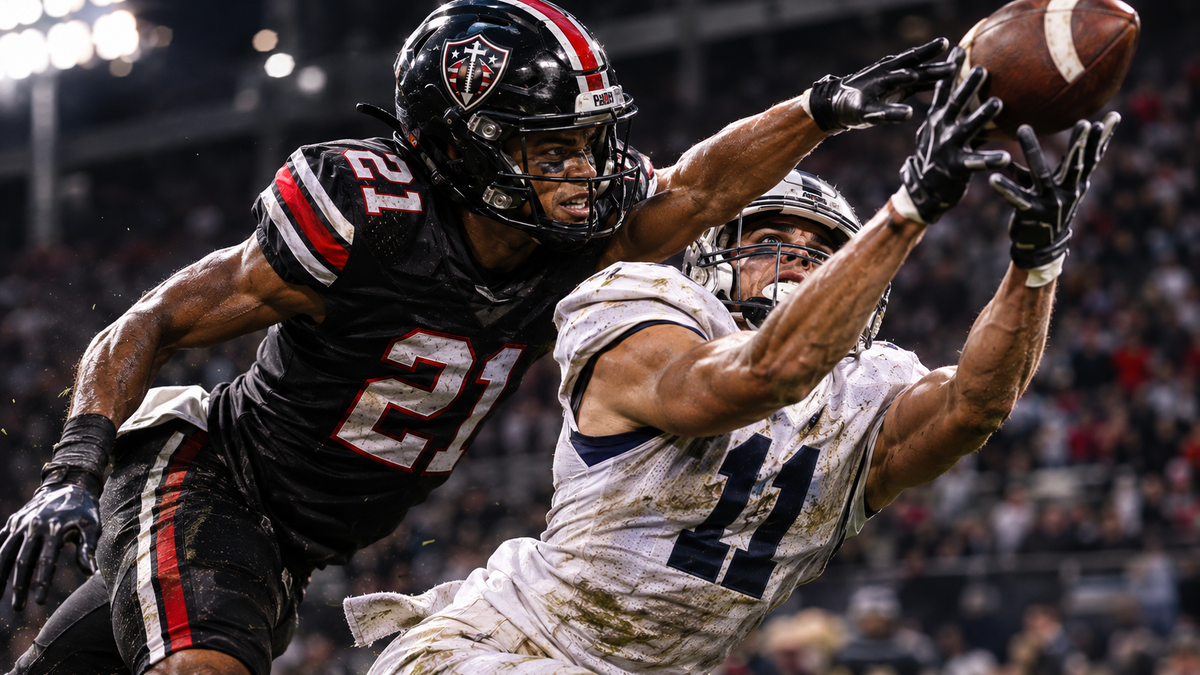
Cornerback number 21 defending a receiver at the catch point

POSITION SKILLS / Linebacker

READ IT. RUIN IT.

See the clue and own your assignment. Make the offense earn every yard.

10 Useful drills4 Quick decisions10 Minute start
Your eyes find the problem. Your feet deliver the bad news.

YOUR REP BOARD

Check off the work you actually complete.

0 drills · 0 decisions · 0 starter steps0 / 17

Come back with a plan

MY NEXT THREE.

Open a drill and save it here. Three useful reps beat a hundred saved tabs.

0 / 3
  1. 01
  2. 02
  3. 03

Your plan stays separate from completed work. Saved on this device and browser.

01 / Start here

Ten minutes. Zero sightseeing.

Warm up first. This is a solo, movement-only rehearsal: name your job, move with control, and leave with one useful cue.

3 STEPS / 10 MIN
10 MINUTES

Your no-contact starter

Clear space, flat markers, and one run-fit diagram or call you already learned from your coach. No ball, partner, pads, or contact needed.

SoloNo contact

Warm up first. Use clear space and your coach’s stance, key and assignment. The time includes resets. Add resistance with your coach at practice.

  1. Open Key Before Chaos →
  2. Open First Two, Stay True →
  3. Open Gap Map →

Check a step after you do it. Uncheck any item to undo.

02 / See it. Then try it.

SEE THE MOVE. OWN THE REP.

Less head-scratching. More “Oh, I get it.” Follow the movement, then connect the picture to your job.

Your call comes first. These pictures name an example assignment. Use your team’s terminology and your coach’s technique.

Your Key Is a Clue. Your Fit Is a Place.Read the right guard; move to the right B-gap fit. The clue and the destination are different markers.See the movement +

This example: Top-down view, offense moving UP. The ball and center sit on the line of scrimmage near the bottom. YOU are on defense above the line. The example call gives YOU right B, the defensive tackle right A, and the end right C, with no exchange. The guard steps inward and the back approaches B. Rehearse a short downhill shuffle toward the marked B fit.

01 / 1 · Name both

Key and Fit — frame 1Offense moves up. The linebacker YOU keys the right guard but owns the right B-gap fit between right guard and tackle. Defensive tackle owns A and end owns C.LOSUPKEY ≠ FITCRGRTQBDTAECB FITKEYYOURB
Locate the key and the fit before moving. Right B sits between the offense's right guard and tackle.Which marker gives you information, and which space is your destination?

02 / 2 · Confirm the clue

Key and Fit — frame 2The right guard steps inward and the running back approaches right B with the ball. YOU takes the first short movement toward the separate B-fit marker, not toward the guard.LOSUPKEY ≠ FITCRGRTQBDTAECB FITKEYYOUSTEP 1RB
The guard moves inward and the back tracks toward B. Use that evidence without following the guard into A.Did the evidence confirm the B-gap fit or order you to chase the guard?

03 / 3 · Fit your space

Key and Fit — frame 3YOU takes the second controlled movement toward B. The tackle still owns A, end still owns C, and the running back carries the ball toward B. The diagram stops before contact.LOSUPKEY ≠ FITCRGRTQBDTAECB FITKEYYOUSTEP 2RBFREEZE · NO CONTACT
The second controlled step stays on the B-gap path. Freeze with balance; A and C still have their own defenders.Can you stop on your path without crossing into a teammate's fit?
Call it before you check it

The guard is your key, but right B is your fit. His inward block and the back's B-gap path confirm the assigned response. Your two controlled steps approach B while the tackle owns A and the end owns C.

Two Defenders. Two Escape Sides.The inside and outside approaches should close different exits, not merge into one lane.See the movement +

This example: Top-down open-field view, offense moving UP. The ball carrier advances from the LOS toward two defenders near the right sideline. YOU start on the field side and own the inside approach; HELP starts on the sideline side and owns the outside approach. The helper retains outside leverage throughout. This illustrates positioning, not a tackle finish.

01 / 1 · Divide the exits

Two Escape Sides — frame 1Offense moves up from the line of scrimmage. Ball carrier is between field-side YOU and sideline-side HELP. YOU owns the inside approach; HELP owns the outside approach.LOSUPSIDELINEINSIDE + OUTSIDEFIELD SIDEHELP SIDEYOUHELPRBINSIDEOUTSIDE
You have the field-side escape. Your helper has the sideline-side escape.Which escape opens if you both run to the sideline side?

02 / 2 · Close together

Two Escape Sides — frame 2The ball carrier advances. YOU closes from the inside and HELP closes from the outside. The two approach paths remain separate and preserve opposite leverage.LOSUPSIDELINEINSIDE + OUTSIDEFIELD SIDEHELP SIDEYOUHELPRBSEPARATE APPROACHES
The runner advances. Both defenders close while keeping opposite leverage.Does each approach still protect a different side of the runner?

03 / 3 · Keep the vice

Two Escape Sides — frame 3The rehearsal freezes with separation. YOU remains field-side and HELP remains sideline-side of the visible ball carrier. Both escape sides remain accounted for; no contact is depicted.LOSUPSIDELINEINSIDE + OUTSIDEFIELD SIDEHELP SIDEYOUHELPRBSTOPBOTH SIDES COVEREDNO CONTACT FREEZE
Freeze short of the runner. Your lanes still close both exits; no one has borrowed the other's job.Are you inside, is help outside, and is there room to stop without contact?
Call it before you check it

YOU stay on the field side and HELP stays on the sideline side. The two approaches cover opposite escapes while the helper keeps outside leverage; the rehearsal stops short of contact.

03 / Make the next play

READ IT. THEN REACT.

Your next move has a job. Read the assignment, spot the clue, and make your call.

4 DECISIONS

Decision 01 / Linebacker

A Key Is Not a Destination

YOUR ASSIGNMENTYou are the linebacker assigned the offense's right B gap on this inside-run call. The right defensive tackle owns A and the end owns C. There is no stunt or gap exchange. Your key is the right guard, then the near back.

The right guard steps down toward the center. The near back takes a downhill track toward the right B gap, between the guard and tackle. Your read confirms an inside run into your assigned space.

Coach’s one-linerA key tells you what changed. The call tells you what that means for your job.

Where does your response take you?

Choose a response to get coaching feedback. You may try again.
Read the answer

Take the taught fit path into right B while tracking the back.

A key tells you what changed. The call tells you what that means for your job.

Use First Two, Stay True and label the fit separately from the key.

Decision 02 / Linebacker

The First Step Was a Bluff

YOUR ASSIGNMENTYou are the backside inside linebacker on a check-flow call. Your rule here is to shuffle with initial flow without crossing the center, then fit the left A-gap cutback if the back plants back left. The frontside linebacker owns the initial right-side run path.

The near back starts right. You take the installed shuffle. Before you cross the center, the back plants and redirects downhill toward left A; that lane is open and the frontside linebacker still owns the right-side path.

Coach’s one-linerRead through the next clue when the call requires it. Do not let the first picture cancel your assignment.

What does this call require now?

Choose a response to get coaching feedback. You may try again.
Read the answer

Redirect with the taught footwork into the left A-gap cutback fit.

Read through the next clue when the call requires it. Do not let the first picture cancel your assignment.

Rehearse the continued-flow and cutback drawings in Check the Flow; name the clue that changes your answer.

Decision 03 / Linebacker

The Quarterback Kept the Receipt

YOUR ASSIGNMENTOn this zone-read play, the defense has explicitly called an Eat exchange to your side: the end takes the running back's dive and you own the quarterback. Your coach has given you the quarterback fit path and leverage; no other defender is replacing you there.

The end squeezes the dive. You can see the quarterback pull the ball from the mesh and head toward your assigned outside lane. The fake is over; the quarterback has the ball.

Coach’s one-linerName both owners before the snap. Confirm the ball after the exchange.

Which responsibility stays yours?

Choose a response to get coaching feedback. You may try again.
Read the answer

Take my called quarterback fit and keep the assigned leverage.

Name both owners before the snap. Confirm the ball after the exchange.

Walk Who Owns the Quarterback? with separate dive and quarterback paths.

Decision 04 / Linebacker

Do Not Carpool with the Help

YOUR ASSIGNMENTThe runner is between you and a teammate near the right sideline. You are on the field side and own the inside approach. Your teammate is on the sideline side, owns the outside approach, and is maintaining that leverage.

The runner continues upfield between the two lanes. You can close from the inside without crossing the runner's path or your teammate's approach. Both escape sides are still accounted for.

Coach’s one-linerTrack the runner and the help. Keep the escape side the situation assigns to you.

Which approach preserves this vice?

Choose a response to get coaching feedback. You may try again.
Read the answer

Keep the inside approach while the teammate closes from outside.

Track the runner and the help. Keep the escape side the situation assigns to you.

Walk Two Lanes, One Runner, then mirror the picture and name the reversed jobs.

Different calls can require different answers. These reps tell you the assignment before the choice.

04 / Drill toolbox

PICK A SKILL. PUT IN WORK.

Pick one thing to clean up. Every drill starts solo and without contact. Open it, grab a cue, and put that cue to work.

10 DRILLS / 5 SKILL AREAS

10 of 10 drills

Eyes & Keys3 MIN

Key Before Chaos

Connect an observed clue to the job in the actual call.

“The backfield is a magic show. Your key is where the rabbit really lives.”

SoloNo contactOpen drill

The setup

Use one familiar team diagram with your coach's key and fit written on it. Stand in clear space facing flat markers for the offensive line.

Your rep

  1. Say your alignment, first key, and fit landmark before moving. Example: 'Read this guard, then the near back; fit the right B gap on this inside run.'
  2. Talk through the diagram's known block and back path. Name the clue that confirms the assigned fit, then walk the corresponding first steps.
  3. Reset and explain which changed clue would require the different response your coach installed. If you do not know that rule, write the question instead of inventing a fit.
“Name the key. Prove the fit.”

Watch for

Looking at every moving jersey and calling the fastest guess a read.

Fix the next rep

Choose the installed key first. Describe what it did before explaining your movement.

Check yourself

Can you identify a visible clue and a specific assignment without saying 'I just followed the ball'?

Your targetExplain two familiar pictures clearly, with a clue and a job for each.
Solo version + next progression
Solo / no contact

A known diagram is a rehearsal. For a genuine solo read, use coach-selected film you have not watched, pause before the snap, and compare your answer with the coaching notes afterward.

Next no-contact rep

Partner / No contact: a coach changes one key's movement in a walk-through while you call the clue and take the assigned first steps. Maintain separation.

Your call: Guard-to-back is one example, not every defense's eye progression. Your first key does not automatically become the spot you run toward.

Eyes & Keys4 MIN

Check the Flow

Keep a second clue from catching your feet already committed to the wrong play.

“One backfield twitch is not a legally binding contract.”

SoloNo contactOpen drill

The setup

Use two familiar drawings of your team's run fits: one with continued flow and one with a coached counter or cutback response. Mark the first fit and the alternate fit on the ground.

Your rep

  1. Read the first drawing aloud: initial key movement, near-back path, and your team's fit rule. Walk the opening movement slowly.
  2. Stop at the moment the second clue matters. Name the back's actual path and walk the response assigned by the drawing.
  3. Rehearse the other drawing. Compare the evidence that changed your answer; do not just practice two different turns.
“First clue. Next clue. Your job.”

Watch for

Opening into a full chase before the call's second clue is clear.

Fix the next rep

Return to the point where you committed. Rehearse the coached read movement that preserves the next response.

Check yourself

Can you show which clue changed while keeping the call's cutback or frontside responsibility intact?

Your targetExplain one continued-flow picture and one counter-flow picture without swapping assignments.
Solo version + next progression
Solo / no contact

Use known drawings for rehearsal. Unseen, coach-selected film can test your read; a cone cannot fake a handoff.

Next no-contact rep

Coach / No contact: walk the two backfield paths in an unannounced order and have the player identify the confirming clue. No chase or collision.

Your call: Some calls send you downhill, some across, and some outside. Read movement and cutback ownership must be defined before the rep.

Feet & Leverage3 MIN

First Two, Stay True

Make the opening movement reach the called fit without losing your balance.

“Your first two steps should not need roadside assistance.”

SoloNo contactOpen drill

The setup

Mark your start and one coach-approved fit landmark. In the page's top-down example, you face the offense and its right B-gap landmark lies ahead toward your left; rehearse the called short downhill shuffle.

Your rep

  1. Set your team's stance and say the exact landmark. Put your eyes on the imagined key while keeping the marker in your peripheral view.
  2. Take two short steps using the movement your coach assigned. In this shuffle example, move toward the right B-gap marker without clicking or crossing your feet.
  3. Freeze before the marker. Check that your feet still support you and that you could stop or change direction without a repair hop; walk back and reset.
“Clue to landmark. Feet underneath.”

Watch for

Taking a giant first step, then pulling the rest of your body back into the rep.

Fix the next rep

Reduce the step enough to keep a usable base. Match the movement to the call rather than trying to win a distance contest.

Check yourself

Did your second step leave you balanced on the assigned path, with your eyes still up?

Your targetKeep three clean freezes. A clean rep has the correct path and no balance-saving extra step.
Solo version + next progression
Solo / no contact

Film one rehearsal from the front if a safely placed phone is available; compare the first and second freeze, not your speed.

Next no-contact rep

Coach / No contact: supply a real key movement for either of two installed fits. The cue chooses the path; the cones only show the landmarks.

Your call: The shuffle shown here is one specific assignment. Crossovers and open-run steps belong in other movements; 'never cross your feet' is not a rule for every LB job.

Feet & Leverage3 MIN

Change Gears

Use the right movement for a short adjustment, an open pursuit, or a coverage drop.

“A shuffle has a speed limit. It is not your interstate gear.”

SoloNo contactOpen drill

The setup

Choose one movement your coach taught. Use flat start and finish markers with room to stop: a short lateral shuffle, an open-and-run path, or a coverage drop to a named landmark.

Your rep

  1. Say the selected movement and why this assignment uses it. Rehearse that single route slowly before increasing to a comfortable practice pace.
  2. Move to the landmark with the taught turn and footwork. For a coverage drop, locate the imagined receiver threat as you open; do not turn into space blind.
  3. Decelerate under control before the finish marker. Reset and compare with a second movement only after you can explain when each belongs.
“Right job. Right gear.”

Watch for

Shuffling so far that you lose ground, or turning to run before a read requires it.

Fix the next rep

Mark where the installed assignment changes from reading or adjusting to covering distance. Rehearse that transition deliberately.

Check yourself

Can you say why you shuffled, opened, or dropped, and finish without stumbling past the landmark?

Your targetShow one controlled rep of two coach-taught movements and explain the difference.
Solo version + next progression
Solo / no contact

These marked paths rehearse movement. They do not test whether you recognized a live run or pass.

Next no-contact rep

Coach / No contact: provide an unannounced, installed run or pass cue. Identify it, then use the corresponding movement with plenty of stopping space.

Your call: Turn direction, eye location, and drop depth belong to the coverage or fit. The page does not prescribe one stance or hip turn for every call.

Run Fits4 MIN

Gap Map

Understand how your fit connects with the defenders beside you.

“Your gap has an address. Stop delivering yourself to your teammate's house.”

SoloNo contactOpen drill

The setup

Lay flat markers for the center, guards, and tackles. Use a real team drawing that names your gap, the nearby defensive line movement, and the neighboring defender's job.

Your rep

  1. Point out the called fit and its boundaries. In a right B-gap example, identify the space between the offense's right guard and right tackle.
  2. Trace the defensive lineman's drawn movement with your finger, then walk your own path to the fit. Leave the neighboring defender's job to that defender.
  3. Return to the start and redraw the picture from memory. If the call includes an exchange or fold, name the actual exchange before changing your path.
“Know the whole fit. Own your part.”

Watch for

Following a moving blocker into a gap that already has a defender while your assignment opens.

Fix the next rep

Return to the call and locate the uncovered responsibility. Change your fit only for the rule or exchange that is actually installed.

Check yourself

Can you point to your fit and the defender covering each neighboring space?

Your targetDraw and walk one complete fit correctly, then explain what would authorize a change.
Solo version + next progression
Solo / no contact

Use a printed or hand-drawn front. Walking a known fit builds assignment recall; it does not prove you can defeat a live block.

Next no-contact rep

Coach / No contact: walk a front with teammates spaced apart. Each player states and moves to the assigned landmark without touching.

Your call: Gaps describe spaces between offensive players; fit ownership can change with the call, a slant, or an exchange. Do not turn 'stay in your gap' into permission to ignore the actual play.

Run Fits4 MIN

Who Owns the Quarterback?

Rehearse a called exchange without sending two defenders after the same ball fake.

“The mesh point is a group project. Check your name on the assignment.”

SoloNo contactOpen drill

The setup

Use a known drawing of your team's zone-read response. Mark the end's starting spot, the dive path, and your assigned quarterback path. No ball or runner is needed.

Your rep

  1. State the call and both jobs before moving. This page's example is an Eat exchange: the end takes the dive and you own the quarterback.
  2. Walk the linebacker path your coach drew, arriving with the called leverage on the quarterback lane. Trace the end's separate dive path with your finger.
  3. Rehearse the give and pull pictures. On a pull, maintain the assigned quarterback responsibility; explain your team's next rule on a give rather than inventing one.
“Call it. Exchange it. Own it.”

Watch for

Following the end toward the dive because the fake looked convincing.

Fix the next rep

Reset both role markers and say who owns each threat. Rehearse your path after the ownership is clear.

Check yourself

When the quarterback pulls the ball, is someone still responsible for him without abandoning another assigned job?

Your targetExplain the give and pull pictures under one installed call with no duplicated owner.
Solo version + next progression
Solo / no contact

Move only yourself through the marked path; the other markers show responsibilities, not opponents to hit.

Next no-contact rep

Coach / No contact: walk the exchange with a quarterback and end at separate landmarks. Use an actual give/pull cue, stop with separation, and discuss the assignments.

Your call: Eat names one published exchange example, not every team's terminology. Other calls leave the end on the quarterback or change the linebacker fit and footwork.

Block Basics3 MIN

Hands + Feet, Air Edition

Rehearse the posture and hand path your coach uses before adding resistance.

“If your feet quit when your hands arrive, half the staff called in sick.”

SoloNo contactOpen drill

The setup

Stand in clear space in your team's taught block-fit posture. Imagine the coach-approved hand targets on a blocker; do not strike a wall, furniture, or another player.

Your rep

  1. Name the block response and the space you must protect. Set your feet so you can move without leaning on an imaginary opponent.
  2. Rehearse the taught hand path into empty space while taking the corresponding short step. Move smoothly and stop short of forcefully locking your elbows.
  3. Freeze with your balance under you, then recover the hands and feet together. Reset if the rehearsal pulls your head or torso ahead of your support.
“Hands work. Feet stay hired.”

Watch for

Reaching with both hands while the feet stay behind.

Fix the next rep

Slow down and shorten the reach until the hand path and step finish in a controlled position.

Check yourself

Can you freeze without needing an opponent to hold you up?

Your targetKeep four balanced air fits with the hand targets and foot placement your coach taught.
Solo version + next progression
Solo / no contact

Use a side-view video to check balance. Air work cannot verify that you can control a real blocker.

Next no-contact rep

Coach / No contact: have a coach inspect your posture and hand targets while you rehearse without touching anyone.

Coach + bag / equipment contact

Optional coach-led bag contact: after the coach checks the air version, rehearse the installed fit against a held pad at the coach's pace. This involves bag contact and needs the team's equipment and progression.

Your call: Hand targets, leverage, and the response to a block depend on the technique being taught. Keep the head out of contact; no head-led strike is part of this drill.

Block Basics3 MIN

Exit on Your Side

Connect a rehearsed block escape to the gap or leverage you still own.

“Getting free is great. Escaping into the wrong gap is a jailbreak with bad GPS.”

SoloNo contactOpen drill

The setup

Mark an imaginary blocker's position with a flat marker and your coach-assigned exit with another. Begin with the block response your coach already taught; this is an air sequence.

Your rep

  1. Say the fit you must preserve and which side the call permits you to exit. Rehearse the taught approach without contacting the marker.
  2. Perform the hand recovery or clearing motion slowly in empty space, then step to the assigned exit marker with your eyes up.
  3. Freeze on the correct side. Point to the runner's drawn path and explain how your finish keeps the assigned space covered.
“Get free. Keep your job.”

Watch for

Taking the easiest-looking exit even though it opens the runner's assigned lane.

Fix the next rep

Put the fit marker back in view. Walk the escape that preserves that job before adding any pace.

Check yourself

Did the escape improve your position relative to the job, or only move you away from the imaginary block?

Your targetComplete one clear air sequence to each side your coach actually assigns, naming the job at the finish.
Solo version + next progression
Solo / no contact

Practice only a known technique in the air. Cones do not teach you the pressure, timing, or resistance of shedding a real block.

Next no-contact rep

Coach / No contact: show different block paths at walking pace from a separate lane. Call the assigned response and rehearse your exit without touching.

Coach + bag / equipment contact

Optional coach-led bag contact: use a coach-held pad to learn the assigned fit and release against resistance. Bag work is contact; the coach sets equipment, pace, and progression.

Your call: A spill, box, wrong-arm, or other block response is a called technique, not a choice to improvise from this card. Learn its contact version with your coach.

Track & Cover4 MIN

Two Lanes, One Runner

Understand your side of a two-defender vice without duplicating the help.

“Two defenders in the same lane is a carpool. The runner did not request one.”

SoloNo contactOpen drill

The setup

Use a flat marker for the runner and another for a helper. Mark the right sideline. In this example, you start on the runner's field side and own the inside approach; the helper owns the outside approach.

Your rep

  1. Point out the runner's inside escape toward the middle and outside escape toward the sideline. State which one each defender is responsible for closing.
  2. Walk your inside approach toward a stop marker short of the runner. Keep your path separate from the helper's outside path; do not cross to the helper's side.
  3. Reset with the positions mirrored and clearly reverse the jobs. Rehearse the outside approach only after naming where the inside help is.
“Find the help. Keep your side.”

Watch for

Both defenders chasing the same shoulder and reopening the opposite escape.

Fix the next rep

Reset the two approach lanes. Track your responsibility relative to the runner and the helper, then close space without merging lanes.

Check yourself

At the freeze, do the two approaches still account for opposite escape sides?

Your targetExplain and walk one inside-help picture and one outside-help picture without swapping jobs mid-rep.
Solo version + next progression
Solo / no contact

The markers let you rehearse leverage geometry. They cannot test your reaction to a cutting runner.

Next no-contact rep

Coach / No contact: two defenders and a runner walk the picture with assigned sides and an early stop line. No tags, collision, wrap, or tackle finish.

Your call: Pursuit can be inside-out or outside-in. Actual tracking changes when the runner moves or help loses leverage; the page picture assumes the helper keeps the stated side.

Track & Cover4 MIN

Drop. Find. Drift.

Rehearse finding a receiving threat while reaching the landmark in your called zone.

“The quarterback is interesting. Staring at him is how a receiver steals your lunch.”

SoloNo contactOpen drill

The setup

Mark a quarterback location, your start, and the landmark for one zone your coach installed. Add two receiver markers along a short known route inside that responsibility. No ball is needed.

Your rep

  1. State the coverage, assigned landmark, and which threat you must locate. Rehearse the coached opening movement while turning your view to find that receiver marker.
  2. Move to your landmark, then drift with the marked route while keeping the depth and leverage the coverage requires.
  3. Reconnect your view to the quarterback marker when your rule allows, and walk a planned break to a separate finish marker. Stop and explain where your responsibility ends.
“Find the threat. Stay in the call.”

Watch for

Dropping to grass without locating a receiver, or chasing a route out of the assigned coverage.

Fix the next rep

Add the threat and the coverage boundary to the drawing. Repeat the sequence with both visible.

Check yourself

Can you identify the threat, your relation to it, and the rule that keeps you from vacating another zone?

Your targetComplete two controlled rehearsals, each with a stated landmark, threat, and coverage boundary.
Solo version + next progression
Solo / no contact

The route and break are planned. This is eye-and-footwork rehearsal, not a reaction or interception drill.

Next no-contact rep

Coach / No contact: a quarterback and receiver supply actual movement within the installed coverage. Keep separation; let the coach set any throw and break progression.

Your call: Some coverages match routes and some pass them on. This card does not tell every linebacker to carry every receiver or use one universal drop depth.

Carry it into practice

ONE CUE. NEXT REP.

Your next rep doesn’t need a motivational speech. It needs one useful cue. What stayed clean, and what will you fix?

Enable JavaScript to save your cue.0 / 180
Built from coaching guidance / Sources & approach

These are original WIN THE DOWN practice adaptations informed by the coaching sources below. The suggested times and rep counts are starting points for this page. Your coach sets the stance, alignment, key, technique and responsibility.

Solo reps rehearse movement and decisions. Work against actual resistance belongs in the separate coach-led progressions. The examples name the responsibility. Your team’s rules and installed calls decide your job.

The Linebacker Receipt

Before you save the rep, leave evidence. A loud 'I got it' is not a film review.

  1. One clue What did you actually see: the assigned key, a changed back path, the ball after the mesh, or the position of your help?
  2. One job Name the fit, leverage, or coverage responsibility in this call. Check whether your movement kept it covered.
  3. One next cue Save a short correction and choose up to three drills for the next session. 'Key first, B fit' is more useful than 'be better.'

CLEAR YOUR REP BOARD?

This clears completed reps and decision answers in this room. Your plan stays saved, and your current cue becomes your last cue. Undo is available until you leave this page.