POSITION SKILLS / OFFENSIVE LINE

WIN THE TRENCHES.

The touchdown starts before anybody sees daylight. Know your job. Own your feet. Give your teammate room to make something happen.

11 Useful drills5 Quick decisions10 Minute start
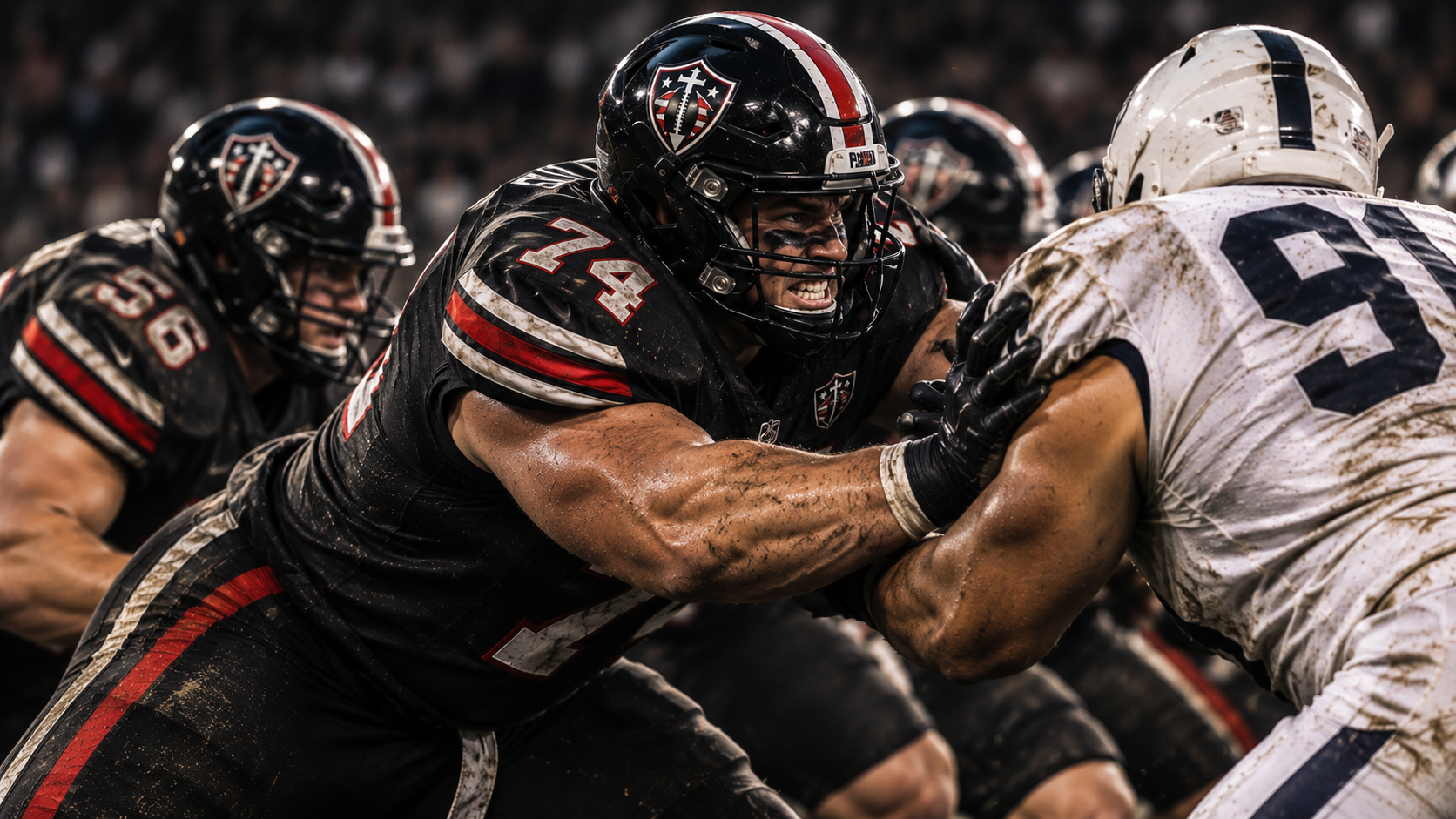
Offensive lineman number 74 driving a defender backward
Five players. One unit. Every rep matters.

YOUR REP BOARD

Check off the work you actually complete.

0 drills · 0 decisions · 0 starter steps0 / 19

Start here

TEN MINUTES. BETTER REPS.

Pick one correction and make it repeatable. Your next practice gets the upgrade.

10 MINUTES

Your solo starter

Stance. Set. Review. A simple place to start with techniques your coach has already taught.

Suggested practice time, not a race. Use clear space and a surface with good footing. Keep this whole starter on air—no collisions.

  1. Open First-Step Freeze →
  2. Open Set. Reset. →
  3. Open The Rep Before the Rep →

Check a step only after you do it. Uncheck any item to undo it.

Make the call

EARN THE REP.

See the problem. Make your call. Take one correction to the field.

Five decisions.
Five useful corrections.

CHALLENGE 1 / CADENCE / DISCIPLINE

Don't Take the Bait

The defender can move early. Your feet don't have to RSVP.

Cadence snapshot: second hut called, first hut heardSchematic of the stated no-contact drill before the snap. The call is on the second hut, but only the first hut has been heard. A horizontal line separates the defender above from the offensive player below. The defender twitches while remaining entirely on his side. The ball is still at the line. No response by the offensive player is shown.CALLED: 2NDHEARD: 1STLINEDYOUBALLSTILLTWITCHHIS SIDENO TOUCH
HERE'S THE PICTURE

You're in a no-contact cadence drill. Your coach called the snap on the second 'hut.' You hear the first one. The defender twitches but stays on his side, makes no contact, and the ball has not moved. What's your next move?

What wins this rep?

CHALLENGE 2 / PASS PROTECTION / BALANCE

Don't Become a Diving Board

Long arms help. Falling forward doesn't.

Mirror-drill problem: partner moved, feet stopped, reach continuedMovement schematic, not an anatomical or measured stance model. A blue partner marker moved right from its dashed former spot. The red YOU marker has a reaching indicator toward the partner, while two red foot markers remain stopped. A cone behind the player marks the protected lane. The drawing shows the stated problem, not the correction, and the players do not touch.PPARTNERYOUREACHFEET STOPPEDLANE CONE
HERE'S THE PICTURE

In a no-contact mirror drill, your partner changes direction several feet in front of you. You reach toward them, your feet stop, and your weight tips beyond your base. A cone behind you marks the lane you're protecting. What fixes this rep?

What wins this rep?

CHALLENGE 3 / FOOTBALL IQ / ASSIGNMENT

Your Block Has an Address

The closest jersey isn't automatically your job.

Assignment snapshot: GOLD is nearer, but your job is unknownPaused walkthrough before the snap. The offensive player marked YOU is below the two stationary defenders. GOLD is visibly closer to the player than RED. The assignment is marked unknown, and no route or blocking path is drawn. The diagram does not identify which defender is the correct assignment.REDGOLDYOUNEARERYOUR JOB?UNKNOWNPAUSED
HERE'S THE PICTURE

Your coach has paused a walkthrough before the snap. Two stationary defenders are marked RED and GOLD. You missed part of the blocking call and aren't sure which one is yours. The nearest defender is GOLD. No rep starts until everyone is ready. What should you do?

What wins this rep?

CHALLENGE 4 / FILM ROOM / WINNING YOUR JOB

The Block That Counts

Your teammate found daylight. Your defender stayed on his feet. Both can be true.

Film snapshot: runner passed while the assigned defender stayed outsideThe marked running lane runs upward on the left. The runner has passed the level of the block. YOU is between the lane and the assigned defender, who remains upright and outside the lane. Text states legal block and no flag, both supplied by the scenario. This is a diagram of the observed outcome, not a block-technique demonstration or a grade.RUN LANERBLEGAL BLOCKNO FLAGYOUDUPRIGHTOUTSIDE
HERE'S THE PICTURE

Your coach assigned you to keep one defender outside the marked running lane. On film, your legal block keeps that defender outside until the ball carrier passes. You stay balanced, avoid a penalty, and stop on the whistle. The defender never falls down. How should you judge the rep?

What wins this rep?

CHALLENGE 5 / COMBO BLOCK / WHO STAYS, WHO CLIMBS

Don’t Drop the Couch

Two blockers. Two jobs. Don’t both let go of the first one.

Frozen combo walkthrough: guard takeover confirmed, coach-linebacker moved outsideTop-down schematic with offense below the line of scrimmage and moving up. Right guard is left of right tackle, who is marked YOU. A defensive tackle cone is beside the guard above the line. The coach-linebacker has moved from a dashed inside position to an outside position on the right. A status box states takeover confirmed. No movement or climb arrow is drawn for either offensive lineman, so the next decision is not shown.TAKEOVERCONFIRMEDLBCOACHOUTSIDEDTLOSRGRTYOUOFFENSE
HERE'S THE PICTURE

You’re the right tackle in a no-contact, walking-speed combo walkthrough. A cone represents a defensive tackle beside your right guard. Your coach represents the assigned linebacker. Today’s rule: once the guard takes over the down defender, you climb if the linebacker moves outside toward you. At the freeze, coach confirms the takeover is complete and walks outside. What do you do next?

This answer belongs to the stated walkthrough. Guard and tackle do not have permanent stay-or-climb jobs; the call, defensive movement, and takeover determine the response.

Coaching source: USA Football · Inside-zone combinations →

Who stays? Who climbs?

Original WIN THE DOWN practice scenarios. Each picture states the job and conditions. Your team's calls and coaching guide your actual reps.

Take it to the field

BUILD YOUR TOOLBOX.

Pick the skill you need. Open the drill. Know what a good rep looks like before you start.

Useful work.
One correction at a time.

11 of 11 drills
Foundation3 min

First-Step Freeze

Get your first two steps headed toward your assignment while keeping a base you can control.

Solo • no contact
Open the drill First-Step Freeze

Your first step is a launch button. Stop hitting the wrong one.

See the three-step visual →

What you need

A flat field stripe or tape marker

Set it up

Pick one run block your coach has taught. Use the team’s stance and mark your starting feet beside a flat line.

Run the rep

  1. Say your assignment and the direction of your first step before getting set.
  2. Take that step, freeze, and check that you can hold your balance without an extra recovery step.
  3. Reset. Add the second step, freeze again, and compare your feet with your coach’s instructions.
Name the jobStep to your landmarkFinish balanced

Spot the mistakeReaching with a huge first step and leaving your body behind.

Make the correctionShorten the step until your body and feet arrive together under control.

Earn a clean rep

Suggested target: five balanced two-step repetitions each direction, with the correct first foot every time.

Your coach sets the stance, first foot, and landmark. Different blocks need different steps.

Coaching source: USA Football — Simple drills that can help offensive linemen improve quickness ↗
Foundation3 min

Cadence Lock

Connect the correct snap cue to your first step so you start with the offense.

Partner • no contact
Open the drill Cadence Lock

Be the first guy moving legally.

What you need

A partner who knows your team’s snap count

Set it up

Have a teammate call your actual team cadence. Agree on the snap count and your first-step assignment before each repetition.

Run the rep

  1. Get set and repeat the snap count to yourself.
  2. Stay still through the earlier sounds. Take your assigned first step only on the correct cue.
  3. Reset and record whether you were early, correct, or late. Mix counts only as your team already practices them.
Know the countListen for the cueMove together

Spot the mistakeGuessing the rhythm and moving before the agreed snap cue.

Make the correctionSlow the cadence down and identify the exact cue before building speed.

Earn a clean rep

Suggested target: eight correct starts. Count early movements separately from late starts so you know what to fix.

If your team uses a silent or visual count, rehearse that system instead.

Coaching source: USA Football — 11 basic fundamentals every offensive lineman should know ↗
Run game3 min

Close the Inside Door

Rehearse reaching your inside-gap assignment with your feet under you instead of diving across it.

Solo • no contact
Open the drill Close the Inside Door

The inside gap isn’t an open invitation.

What you need

One cone and a flat landmark marker

Set it up

Place a cone where an inside defender would align. Ask your coach for the approach landmark, then mark it on the ground with room to stop before the cone.

Run the rep

  1. Identify the inside gap and say which defender your assignment covers.
  2. Take two controlled approach steps toward the marked landmark, bringing your feet with your body.
  3. Freeze before the cone. Check your balance, reset, and repeat from the other side.
Know the inside gapBring your feetArrive under control

Spot the mistakeDiving across the landmark with your upper body while your feet trail behind.

Make the correctionReduce speed and shorten the approach until you can stop without lunging.

Earn a clean rep

Suggested target: five balanced approaches each side, stopping before the cone every time.

This rehearses footwork only. A penetrating defender and a reading defender can require different adjustments from your coach.

Coaching source: USA Football — Teaching safe and effective down blocks ↗
Run game4 min

Pull the Right Path

Learn the route and clearance your specific pull needs before adding blocking traffic.

Solo • no contact
Open the drill Pull the Right Path

You’re the lead car. Take the correct exit.

What you need

Three cones

Set it up

Have your coach define one pull from your playbook. Place cones at your starting spot, the required clearance point, and your destination.

Run the rep

  1. Say the job: kick out a defender, or wrap and lead through the opening.
  2. Walk the approved path, clear the imaginary traffic, and stop balanced at the destination.
  3. Repeat with a little more pace only after the route is clean, then work the other direction.
Name the pullClear the trafficFind your landmark

Spot the mistakeTaking the same path for every pull because they all look like running sideways.

Make the correctionName your target and purpose before you move. Reset the cones for that specific assignment.

Earn a clean rep

Suggested target: three accurate paths each direction without clipping a cone or losing your balance.

Square and skip pulls serve different situations. Cones teach the route; your coach’s half-line work adds real blocking traffic.

Coaching source: USA Football — Teaching the square pull ↗
Hands3 min

Hands Back Inside

Practice replacing a misplaced hand on the pad without surrendering your balance.

Coach + pad
Open the drill Hands Back Inside

Bad hand placement happens. Leaving it there is optional.

What you need

A proper blocking pad or padded training bag, with marked hand targets

Set it up

Have a coach position and support the pad, mark the hand targets, and check your starting fit. Begin with your hands already on the pad; no charge or collision.

Run the rep

  1. Set your feet and place your hands on the coach’s marked targets.
  2. Move one hand slightly off target, then replace it without reaching your whole body forward.
  3. Alternate hands at controlled speed. Reset your feet whenever your posture slips.
Keep your baseReplace one handKeep your head out

Spot the mistakeLeaning your upper body forward to chase the target.

Make the correctionStop and rebuild your base before replacing the hand.

Connect the mirror to the hands

Separate stage · Coach-held pad · Contact

  1. Finish the no-contact mirror and reset. Have your coach support the blocking pad, mark the targets, and set your starting position.
  2. From that stable base, place your hands on the marked targets with your head clear of the pad. This is a controlled fit, not a charge.
  3. Replace one hand at a time while keeping your balance. Stop and reset if you start reaching with your whole body.

The pause separates two learning tasks. It is not a rule to freeze before contact in a game. Your coach teaches the hand technique and timing that fit your protection. Do not turn this into a live rush.

Earn a clean rep

Suggested target: five accurate replacements per hand while keeping your starting balance.

This is supervised placement work, not a strike contest. Use the pad targets; never pull on someone’s neck, facemask, or clothing.

Coaching source: USA Football — Five ways linemen can work on their own into the offseason ↗
Run game3 min

Track Where He’s Going

Adjust your approach to an assigned linebacker’s movement instead of chasing his starting spot.

Partner • no contact
Open the drill Track Where He’s Going

Block the moving problem, not his old address.

What you need

Open space and a partner

Set it up

Stand several yards from a partner representing your assigned linebacker. Agree on the play and coach-taught leverage. Both players walk; leave space between you throughout.

Run the rep

  1. Name the play, your assigned defender, and the side you need to protect.
  2. As your partner walks sideways, adjust your walking approach to the moving target.
  3. Stop with space remaining, explain your path, and reset. Never chase into contact.
See the movementAdjust your pathStay in control

Spot the mistakeCharging toward where the linebacker started while he moves somewhere else.

Make the correctionKeep the defender in view and adjust your approach before you get close.

Earn a clean rep

Suggested target: four controlled approaches each direction, explaining why your path changed.

The play determines your leverage and assignment. This is a walking angle rehearsal, not an open-field contact drill.

Coaching source: USA Football — Simple drills that can help offensive linemen improve quickness ↗
Run game4 min

Two Jobs, One Combo

Coordinate the handoff so your pair accounts for both the down defender and the linebacker.

Coach + teammates
Open the drill Two Jobs, One Combo

Don’t leave your teammate holding the whole couch.

Make the who-climbs decision →

What you need

One cone, a neighboring lineman, and a coach

Set it up

Use a cone as the down defender and a coach as the linebacker. Choose one combination block from your team’s playbook. This is a no-contact walkthrough.

Run the rep

  1. Identify both assigned defenders and communicate your team’s combination call.
  2. Walk the initial paths together. Freeze when the coach shows a linebacker movement and calls for a pause.
  3. Each blocker states who owns the down defender and who takes the linebacker. Walk the coach-approved transition, then reset.
Make the callSecure the first jobKnow who leaves

Spot the mistakeBoth blockers leaving for the linebacker and abandoning the down defender.

Make the correctionFreeze and identify who keeps the down defender before rehearsing the transition.

Earn a clean rep

Suggested target: four correct explanations and transitions against different linebacker paths.

Who leaves, when, and toward which linebacker depends on the scheme and defenders’ reactions. Your coach supplies those rules.

Coaching source: Ken Wilmesherr — Teaching the combo block ↗
Pass protection3 min

SHADOW LOCK

Track a moving partner with your feet while keeping the balance to move again.

Partner · No contact
Open the drill SHADOW LOCK

Your hands do not get to rescue feet that stopped working.

See the three-step visual →

What you need

Two flat markers

Set it up

Mark a short lateral lane. Face a partner with enough space to avoid contact.

Run the rep

  1. Start in the stance your coach teaches. Your partner moves left and right at a controlled pace.
  2. Mirror the movement with your feet. Keep your hands to yourself and avoid reaching.
  3. Freeze on the stop call. Hold your balance, reset, then switch roles.
Feet carry youStay under controlFinish balanced

Spot the mistakeLeaning and reaching to catch a partner who already moved.

Make the correctionSlow the partner down and let your feet carry you into position.

FEET FIRST. HANDS SECOND.

Watch your partner's chest, not every hand fake. Use short, controlled steps so your feet do not bunch together or leave you stuck in a huge base. If your upper body has to reach to keep up, slow the rep down.

FREEZE CHECK

Stop on the call. Can you hold your position and move again without a rescue step? That is the check. Faster only helps when you stay in control.

Earn a clean rep

WTD suggestion: 3 short rounds. Count a clean round when you track under control and finish balanced.

This is a no-contact adaptation. Keep space between players; do not add strikes or a live rush.

Coaching source: AFCA · Christopher Browne's Long Mirror Drill ↗ Torso-read source: USA Football · Steve Ciocci →
Pass protection3 min

SET. RESET.

Connect your team's pass set to a controlled change of direction.

Solo · No contact · Coach-taught set
Open the drill SET. RESET.

The defender is allowed to ask a second question. Keep an answer in your feet.

What you need

Flat tape or field markings

Set it up

Ask your coach to identify your pass set and inside recovery. Rehearse in clear space.

Run the rep

  1. Take your coach-taught set on air, then freeze.
  2. Check your balance and reset at the starting mark.
  3. Add the inside recovery your coach teaches. Finish under control and reset.
Use your team's setKeep your baseBe ready to redirect

Spot the mistakeTaking a huge step that leaves you unable to change direction.

Make the correctionSlow down, shorten the movement, and have your coach check your base.

Earn a clean rep

WTD suggestion: 4 clean repetitions each direction. Film one from the front.

Set angle, depth, stagger, and recovery depend on your position and protection. Have your coach establish them first.

Coaching source: USA Football · Steve Ciocci's pass-protection fundamentals ↗
Football IQ4 min

TWO BLOCKERS. ONE ANSWER.

Recognize a twist and say your protection's job before the picture changes again.

Four players · Coach-led · No contact
Open the drill TWO BLOCKERS. ONE ANSWER.

Two defenders trading places should not make two teammates stop talking.

What you need

Flat markers

Set it up

Two adjacent blockers face two walkthrough rushers. The coach names the protection, assignments, and exchange language.

Run the rep

  1. The rushers walk the twist selected by the coach. Nobody makes contact.
  2. Pause before they cross. Each blocker names the job required by this protection.
  3. Walk through the coach's exchange rule, reset, and try the opposite action.
Know your jobUse your team's callSee it together

Spot the mistakeAutomatically chasing the first jersey you saw.

Make the correctionPause and identify the responsibility your actual protection gives you.

Earn a clean rep

WTD suggestion: Explain your job correctly on 3 looks before the coach increases the difficulty.

There is no universal 'always switch' rule. A coach must direct this walkthrough using your team's protection. Keep it noncontact.

Coaching source: Rick Trickett · Twist drill in Complete Offensive Line ↗
Football IQ4 min

THE REP BEFORE THE REP

Use your setup film to choose one correction with your coach.

Solo film review · No contact
Open the drill THE REP BEFORE THE REP

Give your next rep a better starting point.

What you need

Phone secured outside your movement area

Set it up

Record several normal stance setups from front and rear views. Ask a teammate to film if needed.

Run the rep

  1. Compare your setups. Look for one visible difference from rep to rep.
  2. Show your coach and choose one specific correction together.
  3. Record the corrected setup. Compare the clips and describe what changed.
Repeat your routineLook before judgingFix one thing

Spot the mistakeTrying to fix every body position at once—or guessing what your coach wants.

Make the correctionChoose one coach-confirmed priority and make that change repeatable.

Earn a clean rep

WTD suggestion: Save a before clip, a corrected clip, and one sentence explaining the change.

A stance should fit your body, position, and team technique. Film is a feedback tool; it does not choose the correction for you.

Coaching source: USA Football · LeCharles Bentley's presnap routine ↗

Finish the job. Keep the control.

Use clear space, appropriate equipment, and the supervision listed on each drill. Keep your head out of contact. Pad work belongs with your coach; stop at the whistle.

Your coach supplies the playbook.

Stance, first foot, landmarks, pass sets, and exchanges depend on your body and your team's system. Bring these drills to practice and confirm the details that apply to you.

Coaching sources & how this guide was built

These are original WIN THE DOWN learning scenarios and drill adaptations informed by the coaching resources below. Drill names, simplified practice steps, and suggested times or rep counts are WTD editorial choices. Sources are linked for further learning; their inclusion does not imply endorsement.

We emphasize controlled footwork, clear assignments, balanced movement, and coach-led contact progressions. Some linked sources discuss more advanced or contact-based drills. Follow the version described here and your coach's direction.

The diagrams are original schematic teaching aids, not footage or measured technique models. A practiced mark records your check, not a measured performance gain.

Sources reviewed November 2026.

Reset your rep board?

This clears your Offensive Line drill checks, completed decisions, and starter checklist in this browser.