
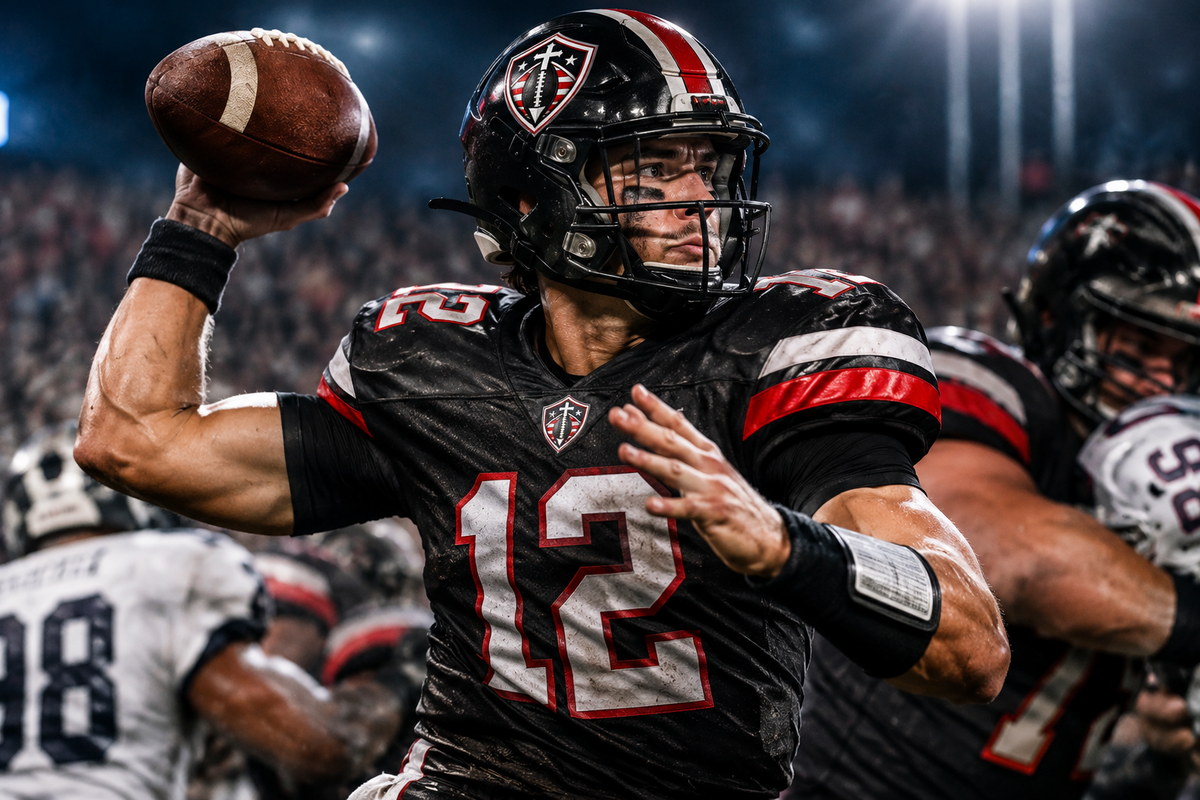
Quarterback number 12 preparing to throw under stadium lights

POSITION SKILLS / Quarterback

OWN THE NEXT PLAY

Know the call. See the clue. Put the ball where the play needs it.

10 Useful drills4 Quick decisions10 Minute start
The defense brought a disguise. Bring a plan.

YOUR REP BOARD

Check off the work you actually complete.

0 drills · 0 decisions · 0 starter steps0 / 17

Come back with a plan

MY NEXT THREE.

Open a drill and save it here. Three useful reps beat a hundred saved tabs.

0 / 3
  1. 01
  2. 02
  3. 03

Your plan stays separate from completed work. Saved on this device and browser.

01 / Start here

Ten minutes. Get your offense together.

Warm up first. These are dry, no-contact rehearsals; the goal is clear decisions and balanced movement, with resets whenever you need them.

3 STEPS / 10 MIN
10 MINUTES

Your no-contact starter

A football, two flat markers, a written play call, and clear level space. No throwing net or partner needed for this starter.

SoloNo contact

Warm up first. Use clear space and your coach’s stance, key and assignment. The time includes resets. Add resistance with your coach at practice.

  1. Open Own the Huddle →
  2. Open Beat the Extra Step →
  3. Open One Read, Two Answers →

Check a step after you do it. Uncheck any item to undo.

02 / See it. Then try it.

SEE THE MOVE. OWN THE REP.

Less head-scratching. More “Oh, I get it.” Follow the movement, then connect the picture to your job.

Your call comes first. These pictures name an example assignment. Use your team’s terminology and your coach’s technique.

Drop to ReadySee the difference between reaching a landmark and arriving able to throw.See the movement +

This example: Dry example: a right-handed quarterback begins in shotgun and uses the three-step drop installed by his coach for an on-rhythm throw. This picture illustrates that one chosen drop, not all shotgun or under-center footwork.

01 / 1 · Know the destination

Drop to Ready — frame 1Shotgun example: offense moves up. Center and ball at the line of scrimmage. Quarterback YOU starts below the line; the launch point is farther from the line; the target is up and right.LOSUPTHIS CALLTARGETCYOUSTARTLAUNCH
Secure the snap. The target and launch point already have a job.Can you point to the start, launch point, and target?

02 / 2 · Follow the coached drop

Drop to Ready — frame 2The same called three-step drop, shown as schematic positions one, two, and three. The valid drop finishes at the launch ring. Extra reach beyond the ring is an explicitly marked comparison.LOSUPTHIS CALLTARGETC12YOU3LAUNCHEXTRA REACH
Complete the assigned sequence without lunging for the last marker.Does the last step leave room for a balanced base?

03 / 3 · Ready on arrival

Drop to Ready — frame 3This call: the on-rhythm drop ends with a balanced base at the launch point. A separate comparison shows stretched feet needing an unplanned reset. A called hitch is not the error being illustrated.LOSUPTHIS CALLTARGETCTHROWREADYYOUREADYTHIS CALLEXTRA RESET
A useful drop ends with an available throw, not a repair project.Can you identify the balanced finish without an extra reset arrow?
Call it before you check it

The READY finish stays balanced at the called launch point. The stretched finish needs an unplanned repair step. A hitch is correct when the play calls for it; this example is an on-rhythm drop.

Picture → Proof → AnswerSame call, three moments: a promising pre-snap window can close. Let the actual movement update the throw.See the movement +

This example: Simplified quick-game example matching the challenge: hitch first, flat next. Take the hitch only when its lane is clear. Here the corner closes the hitch after the snap and the flat lane remains clear. Only the relevant side is shown; this is not a complete defensive coverage diagram.

01 / 1 · The tempting picture

Picture, Proof, Answer — frame 1Same call, first moment: hitch then flat. The corner starts off the outside receiver. Gray arrows are planned receiver routes. Offense moves up, quarterback below the line, right sideline shown.LOSUPSIDELINESAME CALLMOMENT 1CYOUXFCB1 · HITCH2 · FLATPRE-SNAP CLUE
The off corner makes the hitch look possible. Possible is not guaranteed.What fact is visible before the snap?

02 / 2 · The window closes

Picture, Proof, Answer — frame 2Same call, second moment: the corner drives down and inside into the hitch throwing lane. The flat receiver and throwing lane remain clear. Defender movement is blue; routes are gray.LOSUPSIDELINESAME CALLMOMENT 2CYOUXCBFHITCH CLOSEDFLAT CLEARROUTEDEFENDER
The corner drives underneath the hitch. Check the next answer.Which defender movement changed the evidence?

03 / 3 · Use the available answer

Picture, Proof, Answer — frame 3Same call, third moment: the hitch remains closed by the corner. The quarterback uses the available flat prescribed by this call. A visible football travels along the red delivery arrow.LOSUPSIDELINESAME CALLMOMENT 3CYOUXCBFHITCH CLOSEDFLAT AVAILABLETHIS PICTURE
The call gives you the flat next. Its lane is open in this example.Can you name both the rule and the evidence behind the choice?
Call it before you check it

The corner drives underneath the hitch, closing its lane. This call says hitch, then flat; the flat lane is clear here, so it becomes the available answer.

03 / Make the next play

READ IT. THEN REACT.

Your next move has a job. Read the assignment, spot the clue, and make your call.

4 DECISIONS

Decision 01 / Quarterback

The Picture Changed

YOUR ASSIGNMENTPractice example: your quick-game call is hitch first, then the flat. Take the hitch only with a clear throwing window; if the corner closes it, work to the flat. The flat receiver and lane are clear on this rep.

The corner starts seven yards off your outside receiver. After the snap, he drives underneath the hitch. You are set on time and have room to deliver the flat.

Coach’s one-linerThe pre-snap picture starts the plan. Post-snap evidence updates it.

What does the post-snap evidence tell you to do?

Choose a response to get coaching feedback. You may try again.
Read the answer

Work to the available flat and use the called placement.

The pre-snap picture starts the plan. Post-snap evidence updates it.

Draw the same start twice: the corner stays off, then drives underneath the hitch. Name that actual movement before choosing the answer under this call.

Decision 02 / Quarterback

Rent the Pocket

YOUR ASSIGNMENTDrop-back pass. Your coach's rule for this rep is to climb into the clear inside window when the edge rush runs past. The guards and center hold; there is no interior rusher in that window.

Both edge rushers reach your depth on the outside. Your next route is opening downfield. A short inside step creates room to remain a passer.

Coach’s one-linerMove where the space is. Keep the next throw available.

Which movement fits the evidence and the assigned rule?

Choose a response to get coaching feedback. You may try again.
Read the answer

Climb a short distance, stay balanced, and reset to the next read.

Move where the space is. Keep the next throw available.

Mark the clear inside window with a flat marker. Walk the climb and freeze ready; then have your coach show a different pressure picture.

Decision 03 / Quarterback

Keep the Drive Alive

YOUR ASSIGNMENTSecond-and-6. Your installed progression is comeback, dig, then running-back outlet. The first two routes are covered. The outlet is four yards downfield with a clear lane and space to turn up; your protection still gives you time.

The big throw has disappeared. The available outlet can gain useful yards and might earn the first down after the catch.

Coach’s one-linerA smart completion can be the best play available.

What is the best available answer in this situation?

Choose a response to get coaching feedback. You may try again.
Read the answer

Deliver the outlet with the coached placement.

A smart completion can be the best play available.

Compare this with fourth-and-6 and no room after the catch. Explain why the situation can change the value of the same outlet.

Decision 04 / Quarterback

Carry the Offense

YOUR ASSIGNMENTDesigned quarterback run. The pass decision is over. Your coach's rule is to secure the ball in the runner's carry and add two-hand protection before entering traffic.

You are approaching the marked traffic area with the football still swinging away from your body in one hand.

Coach’s one-linerWhen the job changes, the ball position changes with it.

What needs to happen before you enter that area?

Choose a response to get coaching feedback. You may try again.
Read the answer

Tuck it into your coached carry and add the second hand as instructed.

When the job changes, the ball position changes with it.

Walk four passer-to-runner transitions, securing the football before a flat marker. No contact or stripping.

Different calls can require different answers. These reps tell you the assignment before the choice.

04 / Drill toolbox

PICK A SKILL. PUT IN WORK.

Pick one thing to clean up. Every drill starts solo and without contact. Open it, grab a cue, and put that cue to work.

10 DRILLS / 5 SKILL AREAS

10 of 10 drills

Command3 MIN

Own the Huddle

Deliver the complete call so ten teammates can do the same job.

“A play call in your head is a podcast with zero listeners.”

SoloNo contactOpen drill

The setup

Write one installed call with its formation, tags, and snap count. Use your team's actual words and order.

Your rep

  1. Read the card once, then put it face down.
  2. Say the entire call at a clear, steady volume. Pause where your team expects a pause.
  3. Check the card. Correct any missing piece and deliver the whole call again.
“Clear call. Same call.”

Watch for

Racing through the words or letting the snap count disappear at the end.

Fix the next rep

Slow the delivery enough that each part is distinct. Finish the cadence as clearly as you started the formation.

Check yourself

Can you repeat the call without changing its order or a tag?

Your targetThree complete calls with no missing words. This is a page challenge, not a training prescription.
Solo version + next progression
Solo / no contact

Record yourself if useful, then listen for clarity. A recording checks delivery; a teammate checks whether the message landed.

Next no-contact rep

Ask a teammate to repeat the formation, assignment, and count back to you. Fix the communication together.

Your call: Your offense controls the vocabulary, who communicates protection, and when changes are allowed.

Command4 MIN

Picture, Not Promise

Separate what you can see before the snap from what the defense actually does.

“The defense can change outfits after the snap. Check the receipt.”

SoloNo contactOpen drill

The setup

Use a coach-approved clip of a play you know. Pause before the snap; keep the playback controls off the field if you are moving.

Your rep

  1. Name the situation, the visible safety alignment, and your assigned key. State observations before naming a coverage.
  2. Write your expected first answer, then play only the first part after the snap.
  3. Pause again. Name the movement you actually saw and whether it changes the play's answer.
“Picture first. Confirm next.”

Watch for

Calling the entire coverage from the number of deep safeties alone.

Fix the next rep

Describe the shell as a clue, then use the post-snap movement and your installed read to confirm the answer.

Check yourself

Can you point to a visible defender movement that supports your decision?

Your targetExplain three clips using one pre-snap clue and one post-snap clue each.
Solo version + next progression
Solo / no contact

Without film, draw a before-and-after picture from your playbook. Label it a rehearsal rather than a live read.

Next no-contact rep

Have a coach show two looks from the same starting shell. Say what changed before choosing an answer.

Your call: A one-high or two-high picture does not prove a coverage or rule out pressure. Your concept determines which movement matters.

Feet & Timing4 MIN

Window Delivery

Pair a balanced setup with a specific ball-placement target.

“The target ordered a football, not a weather balloon.”

SoloNo contactOpen drill

The setup

After your team's throwing warm-up, use a stable football throwing net in a clear area. Choose a comfortable distance and a small target window approved by your coach. Without a suitable net, use the dry version below.

Your rep

  1. Name the target window and the placement your coach wants for this throw.
  2. Use your coached setup and delivery at controlled effort. Throw into the clear net, then pause.
  3. Compare where the ball arrived with your intended window. Reset your feet and carry one correction into the next rep.
“Set the base. Place the ball.”

Watch for

Adding effort after a miss without noticing whether the setup changed.

Fix the next rep

Reset, keep the next throw controlled, and check one cue from your coach instead of rebuilding your whole motion.

Check yourself

Did you hit the intended window from a balanced setup, or merely hit the net?

Your targetRecord one consistent miss pattern and one cue to take to your coach. Your coach sets throwing volume and distance.
Solo version + next progression
Solo / no contact

With no net, keep the ball in your hands. Rehearse the setup and identify the target; mark it as a dry rep, not an accurate throw.

Next no-contact rep

With a coach and receiver, connect placement to the actual route and defender leverage. Use a clear throwing lane.

Your call: Placement changes with route, leverage, receiver movement, and situation. One target window does not teach every pass.

Feet & Timing3 MIN

Beat the Extra Step

Finish the assigned drop ready for the play's next action.

“Bonus steps are not a loyalty program.”

SoloNo contactOpen drill

The setup

Mark your start and coach-assigned launch point with flat markers. Choose one installed play and its specific shotgun or under-center footwork.

Your rep

  1. Name the play's drop and whether the first throw is on rhythm or needs a coached hitch.
  2. Rehearse that footwork without releasing the ball. Freeze at the moment the first answer should be available.
  3. Check balance and target orientation. Reset if you need an extra shuffle just to become ready.
“Arrive ready.”

Watch for

Overreaching the last step, then needing a second setup before doing anything useful.

Fix the next rep

Reduce the reach and rehearse the assigned rhythm at a pace you can control.

Check yourself

Could you begin your coached delivery from the position you stopped in?

Your targetFour balanced arrivals with the correct footwork for the chosen play.
Solo version + next progression
Solo / no contact

Use dry reps and a side-view recording if available. No screen timer is needed.

Next no-contact rep

Let a coach connect the drop to a receiver's actual route timing. Add throws only within the team's throwing plan.

Your call: This call sets the footwork: a called hitch is part of the play; an unplanned repair step is an error on this drop. Your coach sets which action belongs. Shotgun and under-center drops differ.

Pocket4 MIN

Climb, Don't Drift

Move into a stated clear pocket window while staying ready to pass.

“The pocket is a rental. Don't remodel it.”

SoloNo contactOpen drill

The setup

Use flat markers for a launch point and a clear window a short distance ahead. This example assumes edge pressure has gone past you and the inside window is open.

Your rep

  1. Set at the launch point with the ball controlled and eyes toward your target marker.
  2. Move a short, balanced distance into the marked open window. Keep the movement small enough to stop ready.
  3. Reset to the target, name your next read, and return to the start. Do not throw in this dry version.
“Move to space. Stay ready.”

Watch for

Retreating farther just because a rusher appeared outside.

Fix the next rep

Identify the actual open space first. Rehearse moving into that space without a long lunge.

Check yourself

Did you improve the throwing space while keeping control of your feet and the football?

Your targetFour controlled climbs with no extra retreat.
Solo version + next progression
Solo / no contact

Walk the marked situation. A fixed cone layout rehearses a path; it does not teach pressure recognition by itself.

Next no-contact rep

A coach points to different open windows while helpers represent rush lanes at walking pace, staying clear of the quarterback.

Your call: Climb only when the called play and actual pocket allow it. Interior pressure may require a different answer.

Pocket3 MIN

Slide & Reset

Relocate to a clear side window without letting your base unravel.

“Busy feet don't get extra credit.”

SoloNo contactOpen drill

The setup

Place flat markers for a start and short windows to either side. Name one target downfield. Use your coach's pocket-movement technique.

Your rep

  1. Choose the open side for this rehearsal before moving.
  2. Relocate with controlled footwork while keeping the ball secure and vision toward the target.
  3. Stop balanced, reset toward the target, and say your next read. Walk back and rehearse the other side.
“Move. Reset. Be available.”

Watch for

Letting the feet get so wide, narrow, or tangled that another repair step is needed.

Fix the next rep

Make a smaller movement and recover your coached passing base before adding speed.

Check yourself

Can you stop under control in both directions?

Your targetThree clean relocations each way. Stop the set if the movement quality drops.
Solo version + next progression
Solo / no contact

Use predetermined left and right reps. Do not count them as reactions to a live rush.

Next no-contact rep

A partner gives an unpredictable visual direction cue, then a target cue. Keep helpers outside your movement lane.

Your call: This is a pocket adjustment, not a universal escape rule. The protection and rush determine the usable space.

Reads4 MIN

One Read, Two Answers

Attach a specific action to the evidence your play asks you to read.

“Guessing is a very expensive offensive coordinator.”

SoloNo contactOpen drill

The setup

Pick one installed concept. Write its assigned key, first answer, and next answer on a card. Use a coach-approved clip or diagram for each outcome.

Your rep

  1. State the exact rule: 'If this clue appears, my answer is __; if it closes, I move to __.'
  2. Inspect one clip or diagram, name the visible clue, and choose the matching action.
  3. Dry-rehearse your feet and eyes through that action. Check the installed rule before the next rep.
“See the clue. Use the rule.”

Watch for

Choosing the receiver you like before looking at the assigned evidence.

Fix the next rep

Name the defender movement or open window first, then give the answer.

Check yourself

Can you explain why your other answer was unavailable on this rep?

Your targetExplain both outcomes of the same installed read without changing the rule midway.
Solo version + next progression
Solo / no contact

Use known drawings to rehearse the two branches. For a genuine decision rep, use an unseen clip selected by your coach.

Next no-contact rep

Have a coach vary the key in a controlled walkthrough while receivers run the correct routes without defenders contacting them.

Your call: A progression read, a defender read, and a pre-snap access throw are not interchangeable. Practice the kind your call actually uses.

Reads3 MIN

The Checkdown Has a Job

Find the next available answer when the preferred route is covered.

“The checkdown is on the team too. Learn its name.”

SoloNo contactOpen drill

The setup

Write a specific progression from your playbook. Place flat target markers for its first route, next route, and outlet. No throws are needed.

Your rep

  1. State the progression and the situation, including down and distance.
  2. Use a written scenario that closes the first choices while leaving the outlet and its throwing lane open.
  3. Rehearse your eyes and feet to the outlet, then explain what the completion would accomplish on this down.
“Next answer. Clear lane.”

Watch for

Staring at a covered first choice until the outlet's useful window disappears.

Fix the next rep

Follow the timing and order your coach assigned. A closed answer is information; use it.

Check yourself

Did you check the throwing lane and situation, not just notice an uncovered jersey?

Your targetThree clear explanations of when the outlet helps and one situation where it is not enough.
Solo version + next progression
Solo / no contact

Use playbook scenarios and dry movement. Fixed markers rehearse the progression; they do not simulate moving coverage.

Next no-contact rep

Review a coach-selected clip before the throw and predict the next answer, then compare with the coaching explanation.

Your call: There is no rule that every play ends in a checkdown. Your call, protection time, and game situation set the answer.

Ball Care3 MIN

Secure the Snap

Make control of the football the first part of the play.

“The playbook gets pretty short when the ball is on the grass.”

SoloNo contactOpen drill

The setup

Stand in clear space with the football. Use a small, comfortable self-toss to rehearse receiving the ball; this is not a substitute for working with your center.

Your rep

  1. Begin in the receiving posture your coach teaches for your shotgun alignment.
  2. Give yourself a small toss, track the ball into your hands, and secure it before starting the planned footwork.
  3. Freeze with control, reset, and check that the ball never escaped while your attention moved downfield.
“Own the ball first.”

Watch for

Starting the next action before the football is under control.

Fix the next rep

Separate receiving from rushing. Use an easier self-toss until the catch and transition are clean.

Check yourself

Is the ball controlled when your first planned movement begins?

Your targetFive clean self-toss receives and transitions at a comfortable pace.
Solo version + next progression
Solo / no contact

For an under-center offense, rehearse the stance and transition while holding the ball. Do not invent a one-person center exchange.

Next no-contact rep

Work with your center under your coach's direction. Use the actual alignment, cadence, and snap technique for the offense.

Your call: Shotgun and under-center exchanges need different techniques. The self-toss only practices receiving and control.

Coaching principles:

NFL FLAG: Quarterback Drills

Ball Care3 MIN

Passer to Runner

Rehearse securing the ball when the called play or decision makes you a runner.

“The football is not a shopping bag. Stop swinging it.”

SoloNo contactOpen drill

The setup

Mark a short walking lane and a 'traffic' marker. Use your team's carry technique; no defender, stripping, or collision is involved.

Your rep

  1. Start in a controlled passing posture, then name the decision that makes this rep a run.
  2. Bring the ball into your coached carrying position before walking forward.
  3. Before the traffic marker, add your coach's two-hand security position. Walk through, stop, and reset.
“Runner now. Secure now.”

Watch for

Continuing to carry the ball away from the body after committing to the run.

Fix the next rep

Make the carry transition earlier and keep the football stable as you move.

Check yourself

Did the ball stay controlled through the transition and the marked traffic area?

Your targetFour clean transitions, with the security position established before the marker.
Solo version + next progression
Solo / no contact

Walk the full sequence. Do not add self-stripping, diving, or contact to make it feel harder.

Next no-contact rep

A coach supplies a run-or-pass cue in a walkthrough and checks when you change from passing control to runner security.

Your call: Stay a passer while the play asks you to pass; use the runner's carry once the decision is to run. Your coach teaches traffic and finish rules.

Carry it into practice

ONE CUE. NEXT REP.

Your next rep doesn’t need a motivational speech. It needs one useful cue. What stayed clean, and what will you fix?

Enable JavaScript to save your cue.0 / 180
Built from coaching guidance / Sources & approach

These are original WIN THE DOWN practice adaptations informed by the coaching sources below. The suggested times and rep counts are starting points for this page. Your coach sets the stance, alignment, key, technique and responsibility.

Solo reps rehearse movement and decisions. Work against actual resistance belongs in the separate coach-led progressions. The examples name the responsibility. Your team’s rules and installed calls decide your job.

The QB Receipt

Bring one useful detail out of the rep. The replay button has no feelings. That's why it helps.

  1. My job Name the call, assigned read, and situation in one sentence.
  2. My evidence Name what you actually saw or felt: a closing lane, an extra step, or a loose carry.
  3. My next cue Save one correction for the next rep. Pick up to three drills that help you work on it.

CLEAR YOUR REP BOARD?

This clears completed reps and decision answers in this room. Your plan stays saved, and your current cue becomes your last cue. Undo is available until you leave this page.